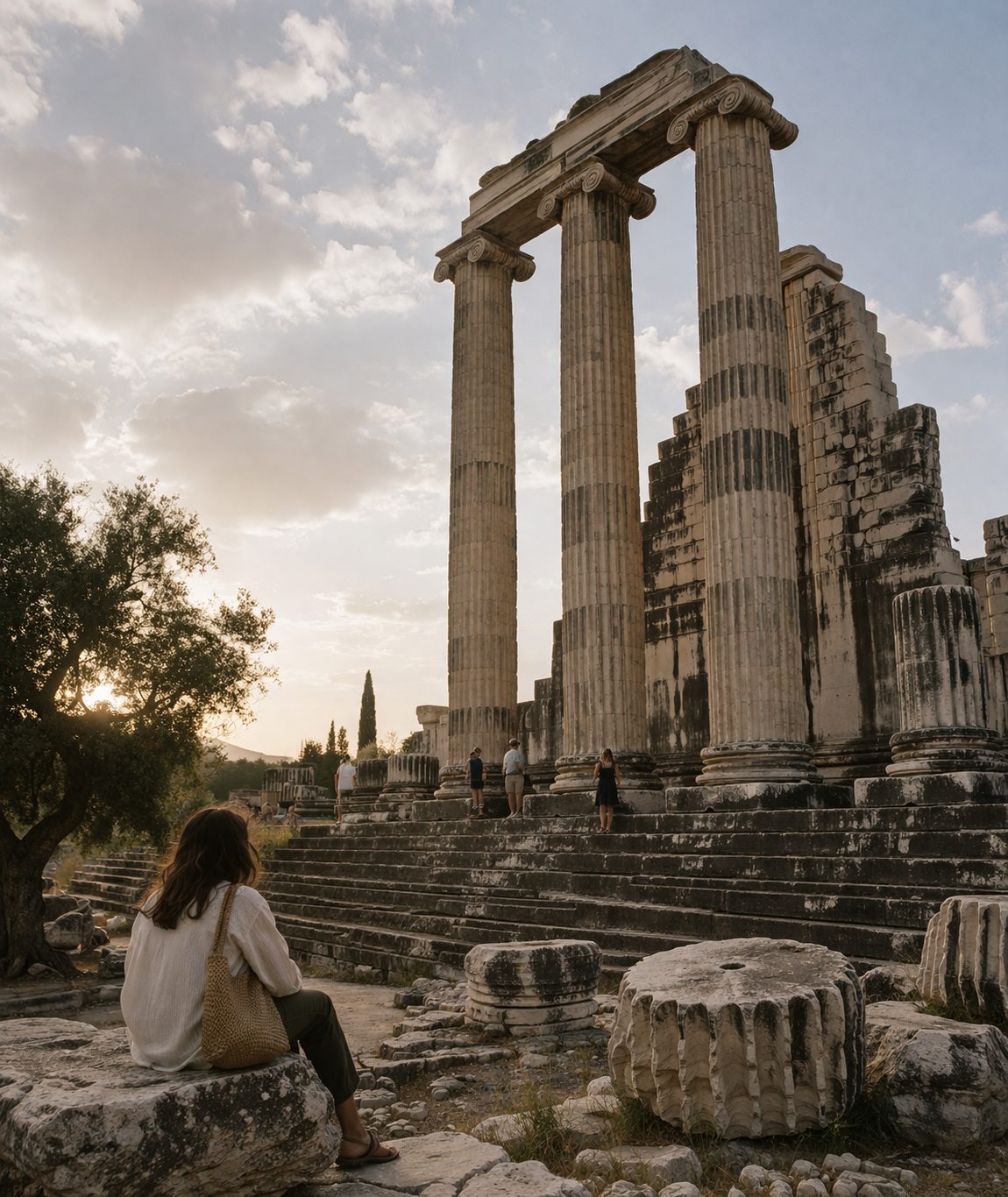
Experience the sheer scale and mystical atmosphere of an ancient oracle, where you can walk among the largest surviving Greek temple columns and sense the spiritual power that drew pilgrims for centuries.
Travelers with severe mobility issues, as the site has uneven ancient pathways and significant ground to cover, though the main temple area is accessible.
- Arrive early to avoid crowds and midday heat
- Wear comfortable shoes for uneven terrain
- Bring water and sunscreen as shade is limited
Spring and fall offer mild weather ideal for exploring the open site; summer is extremely hot with little shade.
About Didyma
The Colossal Ruin of Didyma: Why Apollo’s Oracle Is Worth the Sweat
Let’s get one thing straight: Didyma isn’t Ephesus. There’s no marble-paved Main Street, no reconstructed façades for selfie backdrops. What you get instead is arguably more impressive: a single, unfinished temple so absurdly oversized it makes you question the sanity of the people who started building it.
This was the sanctuary of Apollo Didymaeus—the oracle that gave the nearby city of Miletus its divine street cred. In the ancient world, if you wanted to know whether to start a war, found a colony, or dump your spouse, you’d trek here, pay a priestess, and wait for her to deliver cryptic hexameters while standing over a sacred spring. Today, that spring still bubbles inside the temple’s roofless cella. The columns—all 120 of them originally, though only three stand fully erect—tower 19 meters high. When you stand at their base, you feel like an ant that wandered into a cathedral designed by giants.
What matters most about Didyma is what it didn’t become. Unlike so many ancient sites scrubbed into tidy ruins, this one remains raw. Construction began in 300 BCE and never finished. The Romans tinkered, earthquakes cracked, and eventually the Byzantines hauled away some columns for a church you’ll never find. What remains is the architectural equivalent of a symphonic score with half the instruments missing—still breathtaking, but also brutally honest about time.
Why it matters in a country overrun with “must-see” ruins: it’s the only place where you can still feel the process of antiquity. The unfinished column drums lying in the quarry? They’re still there. The Medusa heads carved with such precision they look freshly chiseled? They stare at you from the temple’s side entrance. You’re not looking at a cleaned-up museum piece; you’re looking at a 2,300-year-old construction site frozen mid-effort.
Best Time to Visit
March through May is the window. The wildflowers along the sacred way haven’t yet turned to dust, temperatures hover in the low 70s Fahrenheit, and the tour buses from Kusadasi haven’t yet reached their July swarm levels. If you come in April, you’ll likely share the site with maybe two dozen people—spread across an area the size of several football fields.
October is your second option, though by late month the winds pick up and the light shifts hard and fast, making photography a race against shadows. Avoid June through August at all costs unless you enjoy feeling like a human kebab. There’s almost no shade inside the temple complex except what little the standing columns throw, and the marble floor radiates heat like a pizza stone. September remains hot but at least the crowds thin after the 15th.
Arrive at opening time (usually 8:30 AM). Not because of crowds, but because the morning light sets the eastern columns on fire and you’ll have the entire sacred spring chamber to yourself—which matters because the acoustics in that space are unnervingly good, and you’ll want silence to hear the water moving under the floor.
Practical Realities
Getting there: You need a car. Didyma sits 2 kilometers from the modern town of Didim (confusingly named after the site). If you’re coming from the direction of Ephesus, it’s a 90-minute drive. Public transport technically exists—minibuses from Söke—but you’ll waste half a day. Rent the car.
What to bring: Water. More water than you think. There’s a small café at the entrance with overpriced sodas, but once you’re inside, it’s a 10-minute walk back to the gate. Sunscreen, a hat, and shoes with grip—the marble steps leading up to the temple platform are polished smooth by 2,000 years of feet and become treacherously slippery when dusty.
Time commitment: Two hours minimum. Three if you want to properly explore the foundations around the temple’s exterior and find the Medusa heads. Four if you’re a photographer who gets stuck in the golden hour spiral. There’s no audio guide worth using; the onsite signage is minimal. Either hire the licensed guide who lurks near the ticket booth (negotiate to about $20) or download a podcast before you arrive.
Cost: Entrance was roughly 200 Turkish lira ($7 USD) last I checked, though Turkey’s inflation means that number changes faster than the weather. Cards accepted at the booth, but bring cash for the parking attendant.
What Nobody Tells You
That sacred spring everyone mentions? You can’t see it. It’s covered by a metal grate inside the chamber that once held the oracle’s shrine, and you’re not allowed to approach it because the structure above is unstable. You’ll hear it, though—that faint trickle echoing off 10-meter walls—which somehow makes it more haunting than if you could simply peer into a hole.
Most visitors miss the north side of the complex entirely. They walk from the entrance to the temple front, circle the standing columns, and leave. If you instead walk around the exterior to the rear (northeast) corner, you’ll find the unfinished column drums scattered like giant stone coins and, more importantly, the tunnel. There’s a vaulted passage that runs beneath the temple floor, once used by priests to move between the cella and the oracular chamber. It’s unlit, rough-hewn, and completely open to walk through if you don’t mind the damp and the dark. Bring your phone’s flashlight. You’ll have it to yourself.
The Medusa heads aren’t on the main temple either. They’re on the propylon—the side entrance gate—which everyone walks past on their way in. Look up. Two of them flank the doorway, carved in high relief, and unlike the famous Medusa at the Basilica Cistern in Istanbul, these haven’t been worn smooth by centuries of moisture. Their snakes still look like they might slither.
Finally: the town of Didim itself is aggressively unremarkable—a sprawl of holiday apartments, kebab shops, and British pubs catering to package tourists. Don’t plan to linger. Eat at one of the lokantas near the main square (look for where Turkish families are eating, not the places with English menus), then get out. The real magic is in the ruins after the day-trippers leave around 4 PM, when the guards stop caring and you can sit on the fallen column capitals and watch the sun drop behind the Apollo temple’s silent, roofless halls.
It’s not Ephesus. It’s better for being unfinished, unpolished, and willing to let you get lost in its scale without a single interpretive sign telling you what to feel.
Gallery
Find destinations near Didyma.